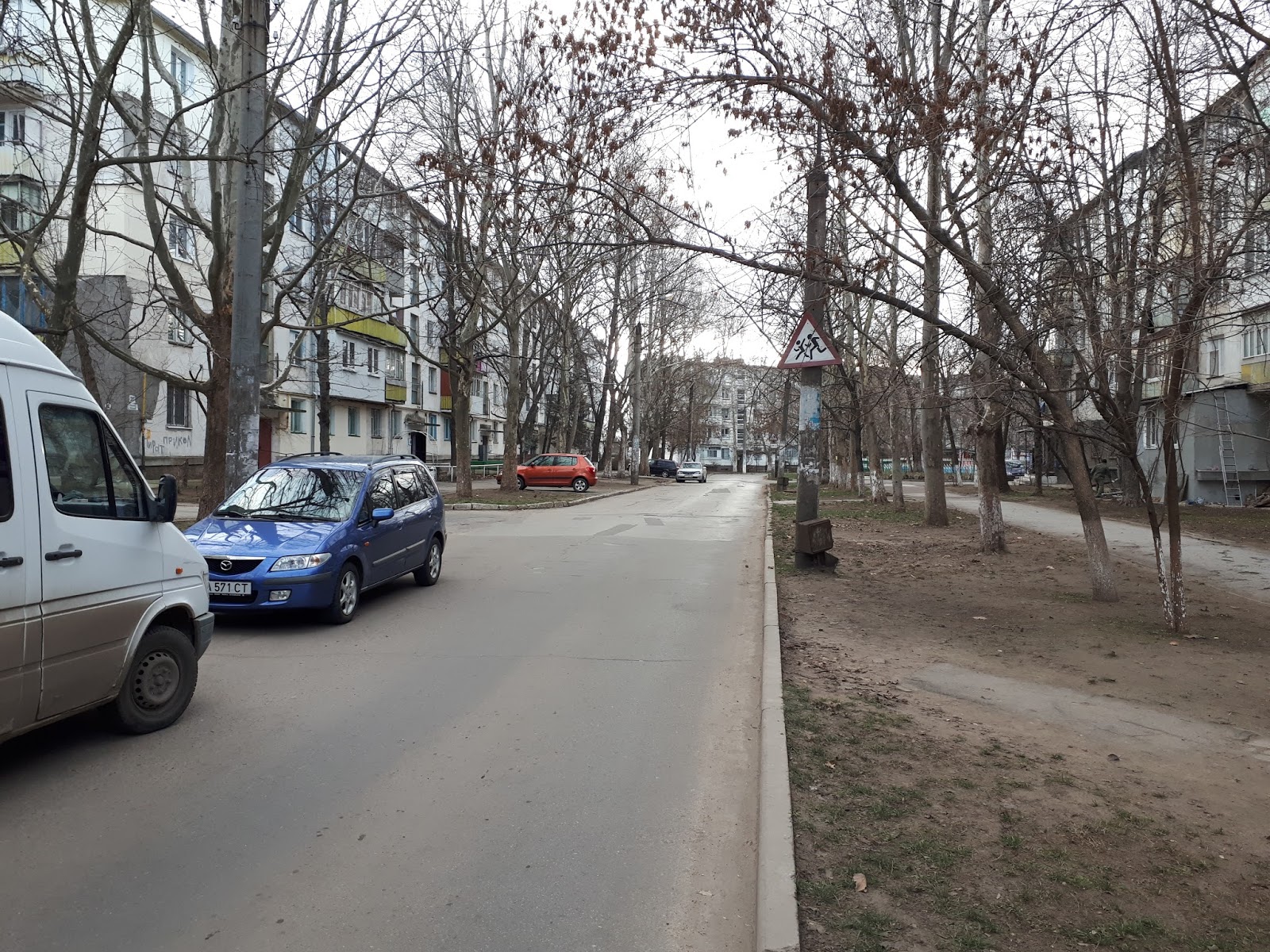
Yesterday, after visiting the monastery in the caves above Butuceny, I had quite the road trip adventure in Transnistria, Ukraine, and Moldova.
Soon after leaving Butuceny, I reached the Dnister River, which more or less serves as the border between Moldova and the de jure breakaway region but de facto nation of Transnistria. Heading east, I crossed the river and immediately came to a checkpoint, which in every way looked like a border crossing. Although, I do not think I have ever been confronted by a tank at a border before, and that was the case here.
The soldiers were wearing big Russian-style fur hats, and they spoke Russian. Also, the signs were in Cyrillic, whereas in Moldova proper all the signs I had seen were in Romanian (and therefore Latin alphabet).
I had to get out of my car and open various doors for the border guards, and they had me open my bag to show its contents. I had a question about my power adapter, but otherwise they seemed uninterested. I showed another border guard my passport, and was given a slip of paper, which was basically a 24 hour visa. And, with that, I was in Transnistria.
Besides the Cyrillic and Russian, there were other indications that I was in a different place, including roadside art/propaganda, much of which suggested pro-Soviet or pro-communist ideology. As I understand it, Transnistria might be the most Soviet-nostalgic place on the planet.
Some of the roadside art seemed just beautiful, without any particular political ideology that I could identify.
Decorated bus shelters seem especially popular.
I was driving maybe half an hour or so through the Transnistrian countryside, generally heading south towards the capital of Tiraspol, which was the location I was especially interested in visiting. But, I realized from highway signs that Odessa, Ukraine's third-largest city on the Black Sea was only about another 100 kilometres southeast. Moreover, Odessa was being referenced (along with Transnistria and Moldovan geography) in the Robert Kaplan audiobook I had begun listening to in Bucharest, and I decided I wanted to try to fit it into my road trip as well. So, at some point I changed roads and instead of entering Tiraspol, headed east to the Ukranian border.
Unfortunately, my assumption about heading down to Odessa was predicated on the border crossing being as quick and painless as it had been coming into Transnistria. In fact, this border was far more popular, for some reason.
Leaving Transnistria was quite simple. Again a man looked into my car, and again I handed over my passport. This time the border guard took the paper slip visa, and I was on my way.
The problem came trying to enter Ukraine. There was a long line up of cars, and countless pedestrians, as well. Many of the pedestrians seemed to have been doing shopping, but it was not obvious to me where the shopping destination was, Ukraine or Transnistria. In other words, people were traveling in both directions with more or less the same amount of belongings.
Anyway, I sat in the line for an hour.
At the Ukranian border I was asked what langauage: "Ukranian or Russian"--at least, that's what I interpreted.
"English," I responded.
Once across, I started out towards Odessa but realized that after losing an hour at the border I was not now going to have enough time to get to Odessa, do anything there, and get back to Moldova before dark. So, I turned around, and headed back to Kuchurhan, the border town.
Here I thought I could go north and cross over into Tranistria at a different border crossing.
I got to a place called Stepanivka (spelt in Cyrillic on the bus stop below--and notice the "CCCP," apparently left over from Soviet times?), and there gave up, because the road was in such bad shape that it would have taken far too long.
So, I returned to the Kuchurhan crossing and re-entered Transnistria. I was disappointed; having gone through the bother of crossing into Ukraine, it was a shame to come back so quickly with nothing to show for it other than a couple of thankfully-more-interesting-than-European passport stamps.
Luckily crossing into Transnistria was quite a bit quicker than exiting had been, and soon I was in Tiraspol.
I had a small itinerary planned, but mostly I was just curious to see the city. Immediately coming into Tiraspol I was struck with how poor it seemed. Moldova is the poorest country in Europe, and I assume Transnistria is even poorer.
My first stop was to see this monument to aviators.
From there, as I headed downtown, I had by far my most interesting Transnistrian experience!
I was navigating partially using Google maps and partially my own sense of direction, and was moving westward along what I think is called Odessa Street. At some point I needed to turn north, and there seemed to be two options. Most traffic seemed to choose the first option, but I was not in the right lane to join them turning north, so I carried on, unworried because I figured I would simply turn at the next block.
There was a red light at the next corner, and I found the signage/intersection configuration quite confusing. I was not sure if I was allowed to turn right on the red light, so I sat there waiting for signalling to change. Meanwhile, fairly casually, a small bus came around me and turned right. "Okay," I thought, "I guess turning right on red is a thing." I followed the bus.
Probably half a block or so down I realized I was in a transit-only lane--the only northbound lane on the street. In essence, the street was one-way southbound, except for the single transit-only northbound lane. Seconds later I realized a police car was coming southbound and pretty much immediately it had its lights on; I was being pulled over my Transnistrian cops.
I assumed playing dumb was my best option--easy when you do not speak Russian and the cops do not speak English. There were two of them: let's call them Alexander and Dmitri. Alexander approached me, looked at the license and documentation I gave him, told me to pull into a driveway, and earnestly tried to communicate what I had done wrong. Eventually he communicated that I should get out of the car and come talk to Dmitri; evidently Alexander was tired of the communication struggle, so he walked off to have a smoke. Meanwhile, Dmitri and I sat side-by-side in the front of the cop car; Dmitri's communication tactic was Google translate.
The strangest part of what happened here was that Dmitri asked me to breathe on his face. He communicated this by opening his own mouth and breathing out then gesturing for me to do the same. I did so, and then he gestured for me to do it again, only this time he wanted me to get right in his face. Presumably this was some type of breathalyzer test, but it was awfully strange. Also, I feel sorry for Transnistrian cops if they need to have drivers breathe in their face all the time.
Anyway, eventually Dmitri makes it clear that I can either pay a "fine" right now to him, or else he needs to do up some paperwork and presumably we will have to go to a police station or something; it turns out Google translate is not necessarily the best tool to communicate with police officers, because many of the words did not translate into anything that made sense in English. He asked for 1,500 Transnistrian rubles, that much was clear.
I tried to let him know I did not have rubles, and we went back and forth for a few more minutes. He was getting very frustrated, and I was eager to finish this. I told him I had to go back to the car. There I leaned in on the side away from him and fished through my wallet. I did not have rubles, but I did have Moldovan lei and euros. I was not about to let Dmitri see my euros, but I took out the lei (about 1,000, or $75 or so [lei and Transnistrian rubles are worth exactly the same, but they are distinct currencies]) and went back to the car. I showed Dmitri the cash. He would not touch it, but he had me spread it out so he could see how much was there. Then he nodded and gestured that I put it in the cup holder. Instead I handed it to him and he expressed frustration--I suppose there must be some distinction made between a cop taking cash in his hand from someone versus simply fishing money out of a cup holder? He would not touch it until it was out of my hands.
Anyway, he was satisfied with the money, and then, much to my surprise, asked me to sign a paper--all in Russian, of course. Given the sketchiness of the situation I was quite surprised that I was being asked to fill out paperwork, but I just wanted to get going, so I was not about to question it. With that, I was free to go, wallet lighter and Transnistrian cops somewhat richer.
I carried on downtown on what is Tiraspol's main drag, October 25 Street. City Hall, besides being a genuinely beautiful building, also has a bust of Lenin out front.
Further down I parked and went shopping at a bookstore called Dom Knigi. I was hoping to find a postcard, but no luck. I did see some poster maps of Transnistria that I was tempted to buy, but cash was now an issue so I did not bother.
There is a square in the centre of Tiraspol just a few more blocks down October 25 Street, so I drove there and parked again (it was a cold, viciously windy day, so I was not walking more than I had to). Here both the Transnistria and Tiraspol flags were flying--note the hammer and cycle on Transnistria's flag.
The 1792 on the Tiraspol arms is a reference to the date the city was founded by Alexander Suvorov, whose statue is on the square.
Transnistria's parliament building is nearby; here Lenin is also honoured, but not just in bust; rather he has some sort of heroic (winged?) statue.
There is also a surprisingly beautiful memorial to the dead from the Moldova civil/Transnistrian independence war.
This is Saint George's chapel, I'm not sure if is part of the memorial or not, but in any case apparently Transnistrians like Saint George too.
A stone's throw from the chapel is this tank--a juxtaposition I found somewhat odd.
And then this poster celebrating Transnistria's 27th anniversary.
After about 15 minutes of walking around the square, I went back to the car and began heading out of Tiraspol. I made one more stop, still eager to find a postcard. The post office was in this neighborhood.
The post office was open on the ground floor of one of these apartment buildings, but they did not have any postcards (I really was not all that surprised). I decided to do a little walk in the neighbourhood. I went through a shopping plaze, and also found this historical site.
As I left Tiraspol, I had a chance to photographically capture something I have found fascinating about Transnistria. Wanna-be-Russia Transnistria has its own oligarch, Victor Gusan, who owns a conglomerate called "Sheriff." Out of all the gas stations I saw in Transnistria (maybe ten total?), most were branded Sheriff, and all the Sheriff gas stations looked fresh and modern.
Gusan also owns Tiraspol's football club, also branded Sheriff, which actually plays in Moldova's football league, and this is their stadium.
Soon after leaving Tiraspol, I reached a bridge over the Dnister River again.
Here, however, the river does not form the border between Transnistria and Moldova, because Bender, the city on the other side, is also part of Transnistria.
As I crossed the bridge I had a view of the Bender's old fortress (originally from Ottoman times, I think).
Currently the fortress is serving as part of a Russian military base. Bender is a city of about 100,000, and is the second largest city in Transnistria. Here were two other features I was able to photograph:
There is a bit of a no-man's land between Bender and Moldova proper, but eventually I reached the border control leaving Transnistria. There is no border control for Moldova, because they do not recognize it as a border.
It was about another hour's drive to Chisinau, where I checked into the Soviet relic known as the Hotel Cosmos.
Here is the map of more or less the route I did starting on Friday afternoon: